


Transformers are critical components of electrical substations, and their design must account for more than electrical performance alone. Because oil-filled transformers can contain significant quantities of insulating oil, the surrounding containment system needs to be carefully designed to limit the consequences of an accidental leak.
A transformer bund provides secondary containment around the transformer, helping prevent oil from escaping into the surrounding environment. Its design must take into account the transformer itself, the available space, the required containment capacity, rainfall and the site’s drainage configuration.
A transformer bund is a secondary containment structure installed around an oil-filled transformer. Its primary purpose is to collect and retain oil in the event of a leak, tank failure or other accidental release.
The bund creates a controlled area around the transformer, providing an additional barrier between the equipment and the surrounding ground or drainage network. It can be constructed as a permanent structure or supplied as a modular or temporary system, depending on the application.
Primary and secondary containment
The transformer tank represents the primary containment for the insulating oil. However, a failure of the tank, valves, connections or other components can result in a significant oil release.
The transformer bund acts as secondary containment. It is therefore an important part of the overall protection strategy for substations where an uncontrolled oil spill could create environmental, operational or safety risks.
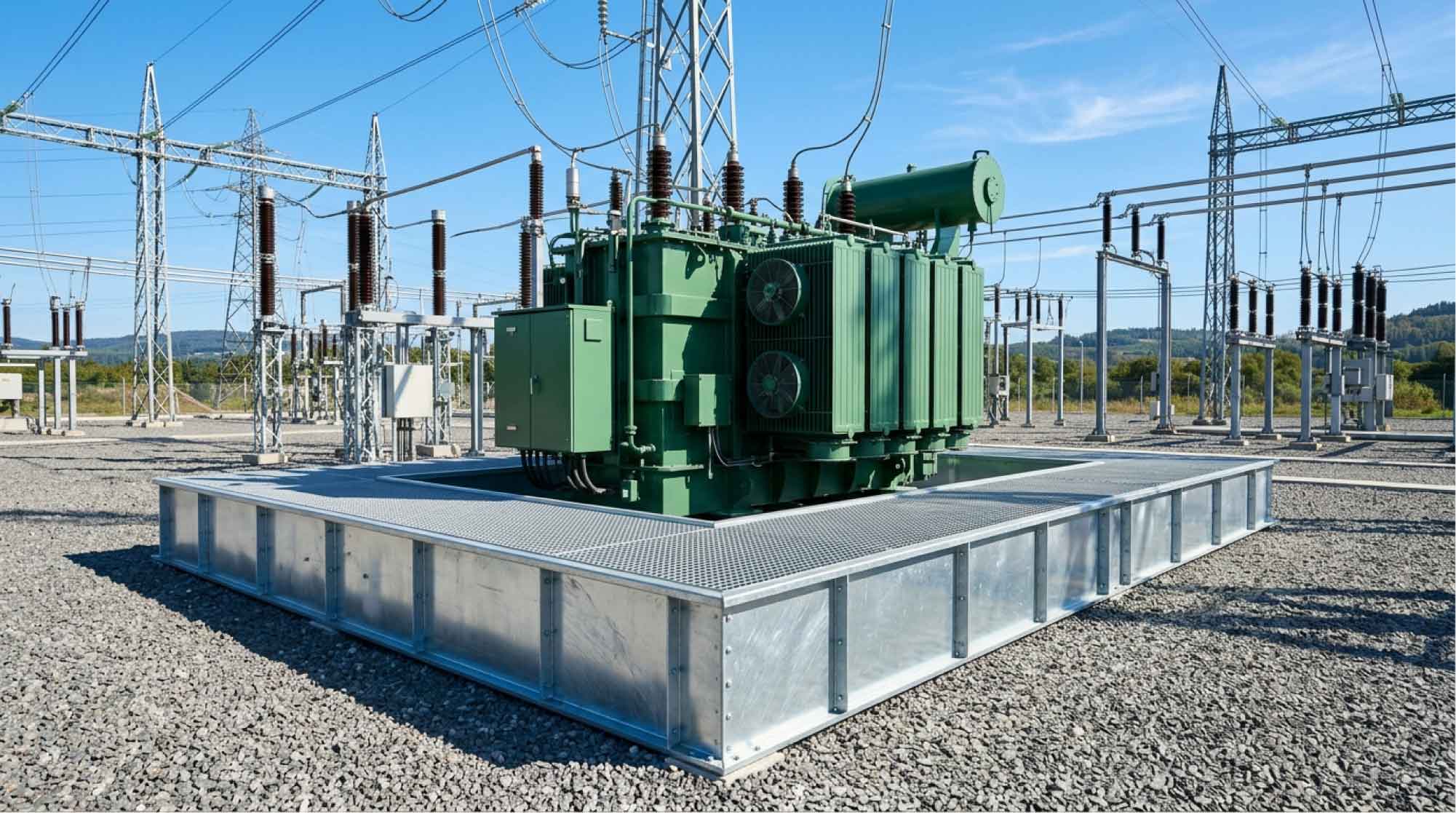
An effective transformer bund needs to be designed around the specific characteristics of the installation rather than treated as a standard enclosure.
Transformer oil volume and containment capacity
One of the first considerations is the quantity of oil that the transformer contains. The containment system must provide sufficient capacity to retain the volume that could potentially be released during a serious incident.
The calculation should also consider the conditions in which the bund will operate, including the possible accumulation of rainwater. The available free capacity must therefore be sufficient to prevent liquids from overflowing outside the containment area.
Transformer dimensions and footprint
The physical dimensions of the transformer directly influence the design of the bund. The containment area needs to accommodate the transformer footprint while leaving sufficient room for safe access and any associated equipment.
Cable connections, radiators, valves, fire protection equipment and other components may also need to be considered during the design stage. A well-designed bund should provide effective containment without interfering with normal operation or access to the transformer.
Rainwater management
Outdoor transformers are exposed to rainfall, meaning that a bund may collect both oil and rainwater.
This is a key design consideration. Without an appropriate method of managing accumulated water, the containment area can progressively lose its available capacity. In addition, water in contact with transformer oil may itself become contaminated.
For this reason, transformer bund design should consider how rainwater will be collected, retained, filtered or discharged under controlled conditions.
Site configuration and drainage
The surrounding site has a direct influence on the design of the containment system. The location of drainage outlets, the site’s gradient, available space and proximity to sensitive areas all need to be assessed.
A transformer bund should prevent accidental oil releases from entering conventional drainage systems. Depending on the installation, this can be achieved through controlled drainage, dedicated filtration or other appropriate liquid-management equipment.
Akhelec provides several transformer containment solutions designed for different transformer configurations and operating situations. The appropriate system depends on factors such as whether the installation is permanent or temporary, the transformer configuration, available space and the required containment approach.
BAF® is suited to permanent transformer installations where both oil containment and fire protection are required. It combines a containment system with an integrated fire suppression approach, making it relevant for substations where transformer oil release and fire risk need to be addressed together.
BAFX® is a modular containment solution designed for transformer installations where flexibility and adaptation to the equipment footprint are important. It is particularly relevant when the containment system needs to be configured around different transformer dimensions.
CRAF® is designed for indoor transformer installations. Its configuration makes it suitable for transformer rooms or enclosed electrical facilities where conventional outdoor bund arrangements are not appropriate and both oil containment and fire protection need to be considered.
BWR® consists of welded steel containment structures designed for high-capacity oil retention. It is particularly relevant for permanent installations requiring a robust solution that can be adapted to specific site dimensions and transformer configurations.
BRX® is a modular steel containment system suited to larger installations or projects where containment dimensions need to be adapted to the site. Its modular construction can make it appropriate for industrial and utility applications requiring scalable containment.
BSTUB® is designed for temporary containment. It can be particularly useful during transformer maintenance, replacement, transportation or temporary storage, when permanent containment infrastructure is not available or practical.
BCAM® is designed for containment during vehicle-based operations, such as transformer transport, loading and unloading, or temporary parking of equipment. It is relevant when the risk of an oil spill exists outside a conventional permanent substation environment.
Effective transformer bund design requires more than simply creating a physical barrier around a transformer. The system needs to be dimensioned according to the oil volume and transformer footprint while also accounting for rainfall, drainage and the specific conditions of the site.
The choice of containment system will depend on the installation itself. Permanent substations, indoor transformer rooms, large industrial facilities, maintenance operations and transport activities can require very different approaches.
Akhelec offers a range of containment solutions designed for these different applications, from permanent steel bunds and integrated fire protection systems to modular and temporary containment solutions.